Table of Contents
- 1. What Is Streaming App Security, and What Should OTT Businesses Know?
- 2. 10 Major Security Threats OTT Owners Must Address
- 1. Unauthorized Access to Premium Video Content
- 2. Credential Theft and Account Takeover
- 3. Password Sharing and Unauthorized Concurrent Streaming
- 4. Screen Recording and Unauthorized Content Capture
- 5. DRM Vulnerabilities Across Devices
- 6. Unauthorized Redistribution and Content Leakage
- 7. Application Tampering and Modified OTT Apps
- 8. Unauthorized Playback Outside Approved Regions
- 9. API Abuse and Exposed Application Data
- 10. Delayed Threat Detection and Inadequate Monitoring
- 3. Building a Stronger Security Strategy for Your OTT Platform
- 4. FAQs
- 1. Why is streaming app security important for OTT businesses?
- 2. How can a secure video streaming app prevent unauthorized content access?
- 3. How does a multi-DRM solution help protect OTT content?
- 4. How can OTT businesses prevent screen recording and video piracy?
- 5. How can businesses prevent account sharing on OTT platforms?
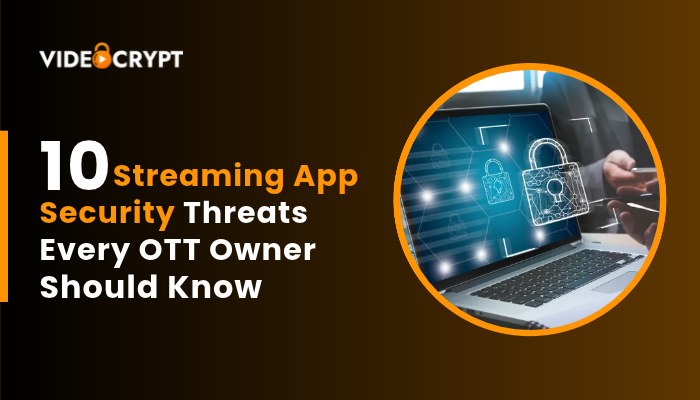
An OTT platform can invest heavily in premium content, original productions, and subscriber acquisition, but a single security weakness can put that investment at risk. Stolen credentials, unauthorized recordings, leaked streams, and weak playback controls can affect both subscription revenue and content ownership. This makes streaming app security an essential part of running a sustainable streaming business.
The scale of digital piracy makes the issue difficult to ignore. According to MUSO’s 2025 Piracy Trends and Insights Report, 185.6 billion visits to piracy websites were recorded across five content sectors during 2025. Although this figure covers multiple forms of digital content rather than OTT streaming alone, it highlights the wider challenge facing content owners.
For OTT businesses, the challenge is not limited to stopping unauthorized downloads. A practical streaming app security strategy must protect subscriber accounts, control playback access, secure applications, and safeguard content across supported devices. Understanding the risks is the first step toward choosing the right protection measures.
What Is Streaming App Security, and What Should OTT Businesses Know?
Streaming app security refers to the technologies and practices used to protect a streaming application, its users, and its video content from unauthorized access, copying, and misuse. It covers everything from subscriber authentication and playback authorization to DRM, application protection, and secure content delivery.
For OTT businesses, security should not be limited to protecting video files. Every stage of the viewing experience needs attention, including how users log in, which devices can access content, how playback permissions are verified, and what happens when someone attempts to record or redistribute a stream.
A practical security strategy should account for three important areas:
- Account and access protection: Ensure that only authorized subscribers can access content and use the features included in their plans.
- Content and playback protection: Use appropriate DRM, encryption, watermarking, and playback controls to safeguard premium video.
- Application and device protection: Identify suspicious application behavior and apply supported security measures across target devices.
Understanding these areas helps businesses identify where their existing platforms may be vulnerable. It also makes it easier to choose relevant protection measures instead of investing in disconnected security features.
10 Major Security Threats OTT Owners Must Address
Let’s examine the 10 security threats OTT owners should plan for and the solutions that can help address them.
1. Unauthorized Access to Premium Video Content
Unauthorized access occurs when someone watches premium content without the required subscription, purchase, or viewing permission. Weak playback authorization, exposed streaming links, and poorly managed access tokens can create opportunities for misuse.
For example, a subscriber might share a playback URL with someone who does not have an active account. If the link remains accessible without proper authorization, the platform may lose control over who can watch the content.
Solution: A secure video streaming app should validate access before allowing playback. OTT owners can implement:
- Short-lived, signed playback tokens to authorize individual requests.
- Subscription and entitlement checks before content delivery.
- Token expiration and rotation to limit the usefulness of intercepted credentials.
- Geo and domain restrictions to enforce distribution permissions.
These measures help ensure that content reaches authorized viewers rather than anyone who obtains a streaming link.
2. Credential Theft and Account Takeover
Stolen login credentials can give attackers access to paid subscriptions, personal information, and premium video libraries. Password reuse, phishing, and compromised email accounts are common ways unauthorized users gain control of subscriber accounts.
Once inside, attackers may change account details, misuse subscriptions, or distribute login credentials to other users.
Solution: OTT streaming platforms should strengthen account authentication and monitor unusual login behavior. Useful measures include:
- Multi-factor authentication where supported.
- Login rate limits to reduce automated password-guessing attempts.
- Alerts for suspicious login activity and unexpected account changes.
- Secure password reset and account recovery processes.
These controls make unauthorized account access more difficult and help operators identify suspicious activity before it creates wider problems.
3. Password Sharing and Unauthorized Concurrent Streaming
Account sharing becomes a business concern when subscribers distribute credentials beyond the permitted household or subscription limits. Some users may even resell access to multiple viewers.
This can increase bandwidth consumption without generating corresponding subscription revenue. However, restricting every multi-device login can also frustrate legitimate customers.
Solution: A platform should enforce subscription policies through session and concurrency management. To understand how to prevent account sharing on OTT platforms, operators should examine:
- Maximum simultaneous streams allowed under each subscription.
- Registered devices and changes in device activity.
- Unusual login locations and repeated session switching.
- Alerts for concurrent sessions that exceed permitted limits.
A practical approach to how to prevent account sharing on OTT platforms should consider normal household viewing patterns before restricting access. Risk-based monitoring helps balance revenue protection with subscriber convenience.
4. Screen Recording and Unauthorized Content Capture
Even when a subscriber has legitimate viewing access, they may record the playback and redistribute the content. This is particularly concerning for premium movies, exclusive shows, paid courses, and early-release content.
A recording can circulate through social media, messaging groups, or unauthorized websites, reducing the value of exclusive content.
Solution: Anti-capture protection can restrict or interfere with screen recording on supported devices and playback environments. When evaluating anti-screen-capture software, OTT owners should consider:
- Screen-capture detection and blocking where supported.
- Secure playback and output-path enforcement.
- Device-level application protection.
- Visible or forensic watermarking to discourage and investigate leaks.
The effectiveness of anti-screen-capture software depends on the operating system, device, and capture method. External cameras and modified devices may bypass these controls.
Therefore, operators researching how to stop screen recording on streaming apps should also verify which devices and playback environments the proposed solution actually supports.
5. DRM Vulnerabilities Across Devices
Different devices, browsers, and operating systems rely on different digital rights management systems. Using an unsuitable or incomplete DRM setup can leave certain playback environments without the intended content protection.
This becomes particularly important for OTT businesses distributing premium content across smartphones, browsers, tablets, and connected TVs.
Solution: A multi-DRM solution helps protect content across supported playback environments by integrating the relevant DRM technologies.
Google Widevine DRM protection can help secure playback on compatible devices through encrypted content and license authorization. The major systems include:
- Google Widevine: Used across supported Android devices and browser environments.
- Apple FairPlay: Designed for content protection within Apple’s supported ecosystem.
- Microsoft PlayReady: Used across supported Microsoft and other compatible environments.
However, Google Widevine DRM protection alone does not cover every device ecosystem. OTT owners should select digital rights management software that supports their target devices and content licensing requirements.
The right digital rights management software should also integrate with the existing video packaging, license delivery, and playback workflow.
6. Unauthorized Redistribution and Content Leakage
A viewer may capture a legitimate stream and upload it to unauthorized platforms. Once redistributed, the content can reach audiences outside the original subscription model, affecting licensing agreements and monetization.
For premium releases and exclusive broadcasts, identifying the source of a leak can be just as important as restricting unauthorized access.
Solution: Forensic watermarking adds an additional layer of content protection. It embeds identifying information into a video session, helping rights owners investigate the origin of a leaked copy.
A multi-DRM solution combined with forensic watermarking can strengthen content protection by addressing unauthorized playback and helping trace redistributed streams.
For effective video piracy prevention for OTT platforms, operators should also consider:
- Session-specific watermarking.
- Encrypted content delivery.
- Secure playback authorization.
- Monitoring for unauthorized redistribution.
These measures support video piracy prevention for OTT platforms without assuming that every leak can be prevented completely.
7. Application Tampering and Modified OTT Apps
Attackers may modify an OTT application, inspect its code, or use rooted and jailbroken devices to bypass certain security controls. Modified applications can expose sensitive application logic or interfere with normal playback restrictions.
This is especially concerning when applications handle premium video, user sessions, and protected playback information.
Solution: Application-level security measures help identify suspicious environments and unauthorized modifications. Depending on the implementation, these can include:
- Root and jailbreak detection.
- Code integrity verification.
- Anti-debugging mechanisms.
- Android emulator detection.
- Runtime application self-protection (RASP).
These measures make it harder to manipulate the application and interfere with its intended operation. They should be tested across supported devices to avoid unnecessarily restricting legitimate users.
8. Unauthorized Playback Outside Approved Regions
Content licensing agreements often restrict where a movie, show, or live event can be distributed. If an OTT service does not enforce these restrictions, viewers outside approved territories may gain access to content.
Unauthorized website embeds can create a similar problem when streams appear on unapproved domains.
Solution: OTT owners should configure access restrictions around their actual distribution rights. A capable OTT platform provider should be able to support controls such as:
- Geo-restrictions based on approved territories.
- Domain restrictions for authorized websites and applications.
- Device and session-based playback authorization.
- Expiring tokens for controlled access.
An experienced OTT platform provider should also help businesses evaluate how these restrictions fit into their existing delivery and playback workflows.
9. API Abuse and Exposed Application Data
OTT applications rely on backend APIs for authentication, subscription management, content catalogs, and playback authorization. If these endpoints are poorly protected, attackers may exploit them to access information, automate requests, or disrupt platform operations.
For example, an exposed endpoint might reveal information that helps an attacker identify content URLs or probe account-related functions.
Solution: API security should be considered alongside video protection. OTT operators should implement:
- Authentication and authorization for sensitive endpoints.
- Input validation and request rate limiting.
- Secure handling of access tokens and application secrets.
- Monitoring for unusual request patterns.
- Regular security testing of application interfaces.
This is an important part of broader OTT security threats and solutions because protecting the video player alone does not secure the entire platform.
10. Delayed Threat Detection and Inadequate Monitoring
Security controls can lose their value when operators cannot identify suspicious behavior in time. Repeated failed logins, unusual concurrent sessions, authorization failures, and leaked content may go unnoticed without proper monitoring.
By the time a problem is discovered, unauthorized access or redistribution may already have affected multiple subscribers and content titles.
Solution: OTT businesses need visibility into application activity and playback behavior. Their monitoring process should cover:
- Login and authentication anomalies.
- Unusual concurrent streaming activity.
- Repeated token and authorization failures.
- Suspicious playback requests.
- Content leakage and redistribution signals.
Threat analytics can help security teams investigate suspicious activity and respond more effectively. A defined incident response process should also cover session revocation, evidence preservation, and communication with relevant rights holders.
Building a Stronger Security Strategy for Your OTT Platform
The ten risks discussed above show why OTT security threats and solutions cannot be addressed through a single feature. Account protection, application security, DRM, watermarking, and playback authorization must work together.
For businesses evaluating how to protect an OTT app from piracy, the starting point should be an assessment of their content, devices, subscription model, and distribution rights.
VideoCrypt offers content protection capabilities through its Content Security and DRM solution and App Security solution.
Its security offering includes multi-DRM licensing, forensic watermarking, anti-screen-capture, secure token authorization, geo and domain restrictions, concurrent-stream limits, piracy monitoring, and encrypted delivery. Application security capabilities include code integrity, root detection, anti-debugging, emulator detection, and runtime protection.
For OTT businesses, effective streaming app security is about making unauthorized access more difficult, identifying suspicious activity, and maintaining control over premium content throughout its delivery lifecycle. The right protection strategy helps safeguard content investments while maintaining a reliable viewing experience.
FAQs
1. Why is streaming app security important for OTT businesses?
Ans. Streaming app security helps OTT businesses protect premium content, subscriber accounts, and application access. Without appropriate safeguards, platforms may face content piracy, account misuse, unauthorized redistribution, and revenue losses.
2. How can a secure video streaming app prevent unauthorized content access?
Ans. A secure video streaming app can combine authentication, playback authorization, encryption, DRM licensing, and access restrictions. These measures help ensure that only authorized users and supported devices can access protected content.
3. How does a multi-DRM solution help protect OTT content?
Ans. A multi-DRM solution supports content protection across different devices and playback environments through DRM technologies such as Google Widevine and other supported systems. It helps enforce content usage and playback permissions.
4. How can OTT businesses prevent screen recording and video piracy?
Ans. Businesses can use anti-screen-capture software, DRM protection, and forensic watermarking to make unauthorized recording and redistribution more difficult. The available protection depends on device and operating system capabilities, so no single measure can prevent every form of capture.
5. How can businesses prevent account sharing on OTT platforms?
Ans. Businesses can apply concurrent-stream limits, monitor unusual login and playback patterns, and use device or session controls where supported. These measures can help identify suspicious account activity and reduce unauthorized access without unnecessarily affecting legitimate subscribers.