Table of Contents
- 1. Understanding the Impact of an eLearning App on Student Performance
- 2. How eLearning Platforms Enable Personalized Learning
- 3. Key Features of High-Performing eLearning Applications
- Interactive, multimedia-driven learning experiences:
- Personalized learning dashboards for learners and educators:
- Continuous assessment with real-time feedback:
- Gamification elements that drive motivation:
- Seamless multi-device access and responsive design:
- Scalable architecture with strong security controls:
- 4. The Role of Data, Analytics, and AI in Learning Outcomes
- 5. Conclusion
- 6. FAQ
- 1. How does an eLearning app improve student performance?
- 2. What are eLearning platforms for personalized learning?
- 3. Are eLearning platforms suitable for flexible and self-paced learning?
- 4. What role do data and analytics play in learning outcomes?
- 5. Why is custom eLearning app development important?
Digital education has moved far beyond recorded videos and static online courses. Today, learners expect experiences that adapt to their pace, respond to their progress, and deliver measurable outcomes. This shift has positioned the eLearning app as a critical driver of modern education, enabling institutions, enterprises, and EdTech providers to improve student performance while scaling learning efficiently.
An effective eLearning application does more than deliver content. It creates structured learning journeys supported by interactivity, real-time feedback, and data-driven insights. These capabilities directly influence engagement, knowledge retention, and overall learning outcomes. From schools and universities to corporate training environments, organizations are increasingly investing ineLearning app development to meet the growing demand for flexible, personalized, and results-focused education.
In this blog, we explore how eLearning platforms improve student performance and learning outcomes, the features that make them effective, and why partnering with an experienced eLearning app development company can be a strategic advantage for building scalable, future-ready learning solutions.
Understanding the Impact of an eLearning App on Student Performance
The impact of an eLearning app on student performance is closely tied to its effectiveness in supporting engagement, comprehension, and continuous progress. Unlike traditional learning models that rely on uniform pacing, eLearning environments are designed to adapt to individual learner needs. This flexibility enables students to learn at a pace that suits them, leading to a deeper understanding and improved academic outcomes.
A well-structured eLearning application integrates interactive lessons, assessments, and instant feedback to keep learners actively involved throughout their journey. Features such as quizzes, practice modules, and progress indicators help students regularly evaluate their understanding. This ongoing reinforcement reduces learning gaps and improves long-term knowledge retention.
Another critical advantage of eLearning apps is performance visibility. Educators and administrators gain access to real-time data on learner engagement, completion rates, and assessment scores. These insights make it easier to identify struggling learners early and provide targeted support. When supported by strategic eLearning app development, platforms move beyond content delivery and become outcome-focused learning systems.
How eLearning Platforms Enable Personalized Learning
Personalized learning is a major advantage of digital education. eLearning platforms tailor content, speed, and tests to each learner, so everyone has a unique experience. This approach improves understanding, keeps students interested, and helps them remember more. By meeting individual needs, eLearning makes learning more effective and helps students succeed.
How eLearning platforms deliver personalized learning experiences:
Adaptive learning paths based on performance:
An eLearning app analyzes assessment results and interaction patterns to adjust lesson difficulty and sequence. Learners who perform well move forward faster, while others receive additional reinforcement without feeling left behind.
Content recommendations aligned with learner needs:
Personalized platforms suggest videos, quizzes, and practice modules based on skill gaps and learning preferences. This ensures students focus on what matters most rather than following a fixed curriculum.
Individual pacing and progress control:
Learners can pause, revisit, or accelerate lessons based on their comfort level. This flexibility reduces pressure and improves confidence, especially for complex or technical subjects.
Real-time feedback and personalized insights:
Continuous assessments provide immediate feedback, helping learners understand mistakes and improve quickly. Educators also gain visibility into individual progress, enabling timely and targeted support.
Scalable personalization through smart eLearning app development:
When built by an experienced eLearning app development company, personalization features can scale across thousands of learners without compromising performance or consistency.
Key Features of High-Performing eLearning Applications
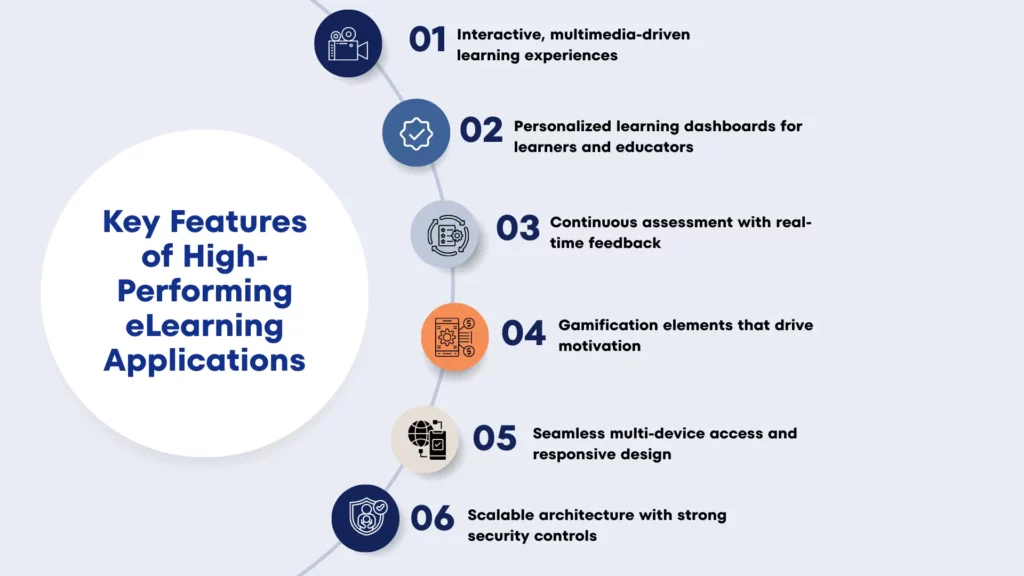
High-performing eLearning applications are built with a clear focus on learner engagement, performance measurement, and long-term scalability. Rather than functioning as simple content repositories, these platforms integrate features that actively support learning outcomes, usability, and administrative efficiency.
When implemented through strategic eLearning app development, these features create a reliable, engaging platform focused on measurable learning outcomes:
Interactive, multimedia-driven learning experiences:
A high-quality eLearning app uses videos, animations, simulations, and interactive exercises to simplify complex concepts. This variety keeps learners engaged and supports different learning styles, leading to higher retention and improved understanding.
Personalized learning dashboards for learners and educators:
Dashboards provide a clear view of progress, completed modules, assessment scores, and learning milestones. Learners stay motivated by tracking their achievements, while educators can quickly identify performance gaps and intervene when needed.
Continuous assessment with real-time feedback:
Built-in quizzes, assignments, and practice tests allow learners to evaluate their understanding regularly. Immediate feedback helps correct mistakes early, reinforces learning, and prevents knowledge gaps from affecting overall performance.
Gamification elements that drive motivation:
Features such as badges, points, certificates, and leaderboards encourage consistent participation. Gamification adds a sense of achievement and competition, which is especially effective in self-paced and long-duration courses.
Seamless multi-device access and responsive design:
Learners expect uninterrupted access across smartphones, tablets, and desktops. Responsive design ensures a consistent learning experience, allowing users to switch devices without losing progress.
Scalable architecture with strong security controls:
High-performing eLearning applications are built to scale as user numbers grow while maintaining performance. Robust security measures protect learner data and support compliance with educational and enterprise standards.
The Role of Data, Analytics, and AI in Learning Outcomes
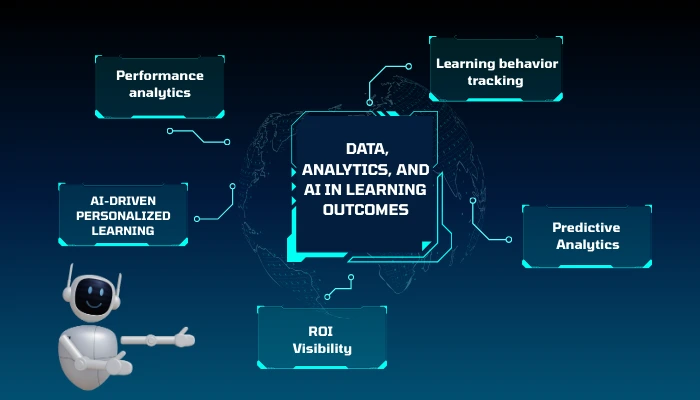
Modern eLearning platforms rely heavily on data, analytics, and artificial intelligence to deliver measurable improvements in learner performance. Rather than depending on static content and assumptions, these platforms continuously analyze learner behavior to optimize engagement, personalize learning paths, and improve overall outcomes.
When implemented through strategic eLearning app development, data-driven and AI-powered capabilities transform eLearning solutions into intelligent, outcome-focused learning systems:
Learning behavior tracking and engagement analysis:
eLearning platforms capture data on how learners interact with content, including time spent on modules, completion rates, and interaction patterns. These insights help educators understand engagement levels and identify areas where learners struggle.
Performance analytics for identifying learning gaps:
Analytics dashboards provide visibility into assessment scores, progress trends, and skill development. This enables timely interventions, targeted support, and more effective instructional strategies.
AI-driven personalized learning experiences:
Artificial intelligence adapts learning paths based on individual performance and behavior. Learners receive content recommendations and practice modules tailored to their needs, improving retention and confidence.
Predictive analytics for proactive learner support:
By analyzing historical and real-time data, AI can predict potential drop-offs or performance risks. This allows platforms to trigger alerts, reminders, or additional resources before learners fall behind.
Outcome measurement and ROI visibility:
Data-driven reporting enables institutions and enterprises to measure the effectiveness of learning programs. Clear metrics help evaluate impact, optimize content strategies, and align learning outcomes with academic or business objectives.
Conclusion
eLearning platforms have fundamentally reshaped how education and training are delivered, measured, and scaled. By combining personalization, flexibility, interactivity, and data-driven intelligence, a modern eLearning app directly improves learner engagement, knowledge retention, and overall performance. What truly differentiates high-impact platforms is not just technology, but how strategically that technology is implemented to align with learning and business objectives.
This is where the right development partner makes a measurable difference. VideoCrypt approaches eLearning app development with a clear focus on outcomes, scalability, and long-term value. From personalized learning experiences to AI-driven analytics, VideoCrypt helps organizations build platforms that go beyond content delivery and actively drive learner success. As digital education continues to evolve, partnering with an experienced team ensures your eLearning solution remains adaptable, secure, and performance-focused. For institutions and enterprises alike, investing with VideoCrypt is an investment in sustainable learning outcomes.
FAQ
1. How does an eLearning app improve student performance?
Ans. An eLearning app improves student performance by enabling personalized learning paths, continuous assessments, and real-time feedback. These features help learners understand concepts more clearly and stay engaged throughout the learning process.
2. What are eLearning platforms for personalized learning?
Ans. These platforms adapt content, pacing, and assessments based on individual learner behavior and performance. This approach ensures that learners receive relevant resources aligned with their specific needs and skill levels.
3. Are eLearning platforms suitable for flexible and self-paced learning?
Ans. Yes. eLearning platforms support flexible and self-paced learning by allowing learners to access content anytime, revisit lessons, and progress at their own speed without time constraints.
4. What role do data and analytics play in learning outcomes?
Ans. Data and analytics provide insights into learner engagement, progress, and performance trends. These insights help educators and organizations improve learning strategies and deliver better outcomes.
5. Why is custom eLearning app development important?
Ans. Custom eLearning app development ensures the platform aligns with specific learning objectives, scalability requirements, and integration needs. It offers greater flexibility and long-term value compared to generic solutions.