 Offer 1 month Unlimited streaming VOD & Live with VideoCrypt Mobile App For Educational institute and Youtube Creators*
Digital education is evolving rapidly as institutions and businesses adopt smarter, more flexible learning models. Learners now expect personalised experiences, real-time support, and access across devices, making eLearning app development a critical focus for modern education providers.
Artificial Intelligence is transforming every advanced eLearning platform by enabling adaptive learning paths, intelligent content delivery, and automated learner assistance. From AI chatbot integration in eLearning apps to data-driven insights within AI-based learning management systems (LMS), AI-powered eLearning applications are improving engagement and learning outcomes at scale.
Supported by secure and scalable cloud-based learning platforms, AI-driven innovation is shaping the trends driving modern education platforms today. For every eLearning app development company, understanding these shifts is essential. This blog explores 9 AI-driven eLearning app ideas currently dominating the EdTech landscape.
Why AI Is Reshaping eLearning App Development
Artificial Intelligence has become a foundational technology in modern eLearning app development, redefining how digital education platforms deliver value to both learners and educators. Unlike traditional systems that follow a one-size-fits-all approach, AI enables intelligent automation, personalisation, and continuous improvement across every eLearning platform.
One of the biggest advantages of AI is its ability to analyse learner behaviour in real time. By tracking engagement levels, progress patterns, and performance data, AI-powered eLearning applications can adapt content difficulty, recommend relevant modules, and personalise learning paths. This ensures learners stay motivated while achieving measurable outcomes, making AI a core component of the trends driving modern education platforms.
AI also strengthens operational efficiency through AI-based learning management systems (LMS). These systems automate assessments, generate performance insights for instructors, and simplify content management at scale. Combined with AI chatbot integration in eLearning apps, learners receive instant support, guidance, and feedback without relying on manual intervention.
When deployed on secure and scalable cloud-based learning platforms, AI-driven eLearning solutions support global accessibility, real-time collaboration, and seamless updates. For any forward-thinking eLearning app development company, integrating AI is no longer just an enhancement; it is a strategic necessity that is shaping the future of digital education.
Top 9 AI-Driven eLearning App Development Ideas
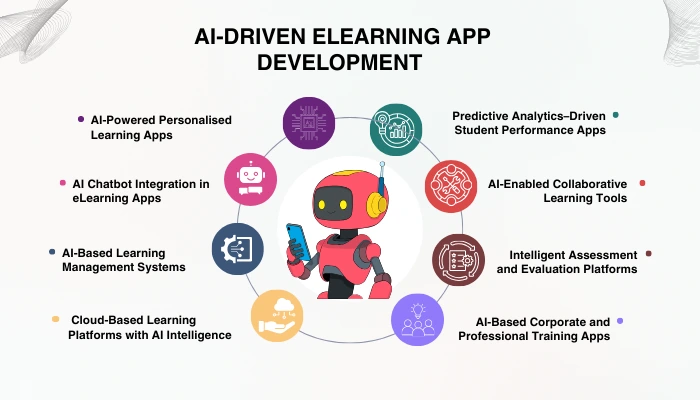
AI is no longer an experimental add-on in digital education. It is actively shaping how modern eLearning apps are designed, delivered, and scaled.
Below are nine AI-driven ideas that are defining the next generation of eLearning platform innovation and setting benchmarks across EdTech:
1. AI-Powered Personalised Learning Apps:
AI-driven personalisation is redefining how learners engage with an eLearning app. These applications analyse learner behaviour, performance trends, and preferences to create adaptive learning journeys. Instead of static courses, learners receive customised content, pacing, and assessments aligned with their skill levels and goals. This approach improves retention and ensures consistent progress across diverse learner groups.
Key features include:
- Adaptive learning paths based on performance
- Skill gap identification and targeted content delivery
- Continuous progress tracking and recommendations
2. AI Chatbot Integration in eLearning Apps:
AI chatbot integration in eLearning apps enables instant learner support without manual intervention. AI-powered chatbots assist with onboarding, answer course-related queries, provide reminders, and guide learners through modules. This significantly reduces response time while improving user engagement and satisfaction.
Key features include:
- 24/7 learner assistance
- Automated doubt resolution and FAQs
- Personalised learning nudges and reminders
3. AI-Based Learning Management Systems (LMS):
Modern AI-based learning management systems (LMS) go beyond course administration by offering intelligent insights and automation. These systems analyse learner data to recommend content, monitor progress, and generate actionable reports for educators and administrators.
Key features include:
- Intelligent course and content recommendations
- Automated assessments and feedback
- Real-time analytics for instructors
4. Cloud-Based Learning Platforms with AI Intelligence
AI-enabled cloud-based learning platforms provide scalability, security, and seamless access across regions and devices. Cloud infrastructure allows AI models to process large data sets efficiently, enabling real-time updates and uninterrupted learning experiences.
Key features include:
- Global accessibility and scalability
- Secure data storage and compliance
- Real-time platform updates and performance optimisation
5. Predictive Analytics–Driven Student Performance Apps
Predictive analytics uses AI to identify learning risks before they impact outcomes. These eLearning applications monitor behavioural patterns and performance metrics to forecast potential drop-offs or skill gaps, enabling timely intervention by educators.
Key features include:
- Early identification of learning challenges
- Data-driven intervention strategies
- Improved learner success rates
6. AI-Enabled Collaborative Learning Tools
AI-powered collaborative learning tools enhance peer interaction by intelligently grouping learners based on skills, interests, and learning objectives. AI also monitors participation levels and provides insights to educators to improve collaboration quality.
Key features include:
- Smart peer and group matching
- AI-driven engagement analysis
- Enhanced knowledge sharing and teamwork
7. Intelligent Assessment and Evaluation Platforms
AI is transforming assessments by enabling automated grading, unbiased evaluation, and instant feedback. These platforms improve accuracy while reducing manual workload for educators within large eLearning platforms.
Key features include:
- Automated grading and evaluation
- Real-time learner feedback
- Reduced assessment bias
8. AI-Based Corporate and Professional Training Apps
Enterprises are increasingly adopting AI-driven eLearning app development for employee upskilling and reskilling. These platforms personalise training programs based on roles, performance data, and career goals, ensuring continuous workforce development.
Key features include:
- Role-based learning journeys
- Performance-linked training modules
- Scalable enterprise learning solutions
9. Multilingual and Voice-Enabled AI Learning Apps
AI-powered language processing enables inclusive education through multilingual support and voice-based interactions. These eLearning applications help overcome language barriers and improve accessibility across global learner bases.
Key features include:
- Speech recognition and voice commands
- Multilingual content delivery
- Improved accessibility and learner engagement
Key Benefits of AI-Driven eLearning Applications
These benefits make AI a core component of successful eLearning app development strategies today:
- Personalised learning experiences:
AI adapts content, pace, and difficulty based on individual learner behaviour, improving engagement and completion rates across every eLearning app.
- Higher learner engagement and retention:
Smart recommendations, adaptive assessments, and real-time feedback keep learners actively involved and reduce drop-offs.
- Efficient learning management and automation:
AI-based learning management systems (LMS) automate grading, reporting, and performance tracking, reducing manual effort for educators and administrators.
- 24/7 learner support:
AI chatbot integration in eLearning apps provides instant assistance, course guidance, and query resolution without additional support resources.
- Scalable and reliable delivery:
Deployed on cloud-based learning platforms, AI-powered eLearning applications support large user bases with consistent performance and availability.
- Actionable data and insights:
AI-driven analytics help institutions and businesses make informed decisions aligned with the trends driving modern education platforms.
- Cost efficiency for education providers:
Automation and intelligent resource allocation lower operational costs while improving overall learning outcomes.
Choosing the Right eLearning App Development Company
Choosing the right development partner plays a decisive role in the success of your digital learning initiative. A capable eLearning app development company ensures your platform is scalable, intelligent, and aligned with evolving education needs.
These factors help ensure your eLearning application delivers consistent value and sustainable growth:
- Proven expertise in eLearning app development:
Look for a company with hands-on experience building scalable and secure eLearning apps across academic, corporate, and professional learning environments.
- Strong AI and automation capabilities:
The right partner should be skilled in AI chatbot integration in eLearning apps, intelligent analytics, and AI-based learning management systems (LMS).
- Experience with cloud-based learning platforms:
Cloud expertise ensures high availability, data security, and seamless scalability for growing user bases.
- Understanding of modern education trends:
A reliable development company stays aligned with the trends driving modern education platforms and designs future-ready solutions.
- Focus on collaborative learning tools:
The ability to implement smart collaboration features enhances learner interaction and engagement.
- Security, compliance, and data privacy:
Ensure the company follows global standards for data protection and secure application development.
- Post-launch support and scalability planning:
Ongoing maintenance, upgrades, and performance optimisation are essential for long-term platform success.
The Future of AI in eLearning Platforms
AI has moved from being an innovation layer to becoming the backbone of modern eLearning platforms. From personalised learning journeys and intelligent assessments to collaborative learning tools and automated learner support, AI is reshaping how digital education delivers measurable impact. Platforms that embed intelligence across content, analytics, and engagement are setting new standards for learning effectiveness.
As cloud-based learning platforms continue to scale globally, AI-driven eLearning app development enables secure, flexible, and outcome-focused education delivery. Solutions like VideoCrypt are playing a key role in this shift by combining AI-powered video learning, intelligent analytics, and scalable infrastructure to support modern learning needs. For institutions, enterprises, and every forward-looking eLearning app development company, leveraging AI-led platforms such as VideoCrypt is essential to stay aligned with the trends driving modern education platforms and to build future-ready digital learning ecosystems.
FAQs
1. What is eLearning app development, and why is it important today?
Ans. eLearning app development focuses on building digital platforms that deliver flexible, scalable, and personalised learning experiences. It is essential today due to the growing demand for remote learning, continuous upskilling, and data-driven education models.
2. How does AI improve the performance of an eLearning platform?
Ans. AI enhances an eLearning platform by enabling personalised learning paths, intelligent assessments, real-time analytics, and automated learner support, resulting in higher engagement and better learning outcomes.
3. What role do AI-based learning management systems (LMS) play in digital education?
Ans. AI-based learning management systems (LMS) automate content recommendations, performance tracking, grading, and reporting, helping educators and organisations manage learning at scale more efficiently.
4. Are cloud-based learning platforms secure and scalable?
Ans. Yes, cloud-based learning platforms are designed to offer high security, reliable performance, and seamless scalability, making them ideal for supporting large and geographically distributed learner bases.
5. How do collaborative learning tools enhance eLearning applications?
Ans. Collaborative learning tools use AI to facilitate peer interaction, group learning, and engagement tracking, creating more interactive and effective learning experiences within modern eLearning applications.