 Offer 1 month Unlimited streaming VOD & Live with VideoCrypt Mobile App For Educational institute and Youtube Creators*
Opening an OTT company today is one of the highest margin plays for businesses, broadcasters, and content providers. As demand for VOD streaming services and video on demand players has never been higher, industries are turning to OTT as an additional revenue stream. The best part about it is that with the appropriate strategy, technology, and positioning, you will be able to construct an OTT platform for your business that is attractive to viewers and sustainable in profitability.
Over-the-top (OTT) services have become highly profitable revenue streams across sectors such as media, education, and fitness. Launching an OTT platform enables direct audience engagement and offers diverse opportunities for revenue generation.
The rapid rise of video-on-demand (VOD) streaming highlights the growing consumer preference for convenience and personalized viewing experiences. However, the success of an OTT platform depends on more than just video content. It requires an integrated strategy, a scalable technology infrastructure, and a strong competitive edge in the market.
Launch a Profitable OTT Platform: 7 Essential Tips:
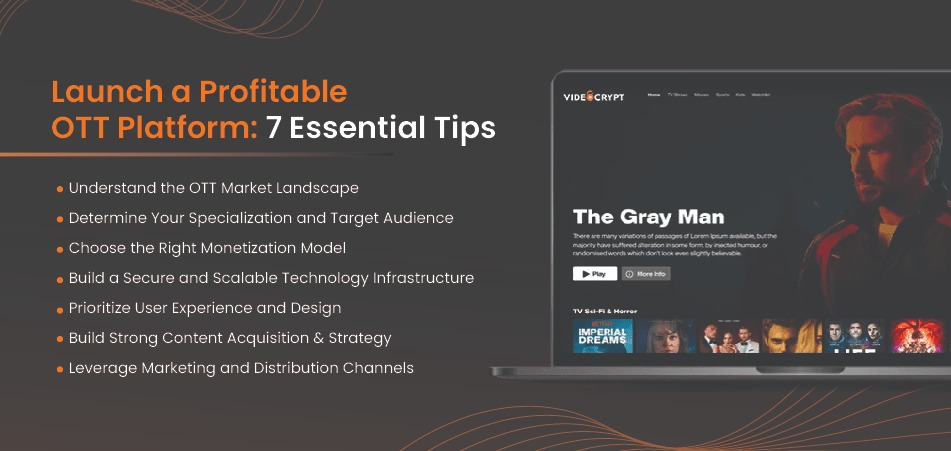
Understand the OTT Market Landscape
Companies should thoroughly understand the OTT ecosystem before investing. As world revenue is set to rise dramatically, competition is stiff. Established businesses dominate mainstream sectors, while niche-based platforms excel in specific niches, including fitness, education, and local content.
Market trend analysis enables you to:
- Determine consumer interests such as live streaming, bingeing content, or micro-learning.
- Find spaces where others have left unvisited.
- Expect regulatory roadblocks, licenses, or technological issues.
Clear insights into the market scenario enable an OTT platform for your business to be ready for a successful launch and sustainable development.
Determine Your Specialization and Target Audience
Launching a broad, all-inclusive OTT platform may seem attractive, but businesses often see greater success by focusing on niche markets. Specialization not only helps you stand out in a competitive landscape but also drives stronger customer engagement and long-term loyalty.
A white label OTT platform makes this approach even more effective by allowing you to customize branding, features, and user experience to serve specific audience needs.
Some common examples include:
- Corporate learning and training modules for enterprises.
- Health and wellness sessions for fitness communities.
- Local and regional content libraries tailored for cultural or ethnic audiences.
By clearly defining your target audience, you reduce customer acquisition costs and maximize ROI. A focused audience also makes it easier to align your marketing campaigns, content strategy, and pricing models for better conversions and profitability.
Right Monetization Model
Business Profit Basics are based on selecting an appropriate business model. Current providers of video on demand are counting on various models of revenue generation, including:
- Subscription Video on Demand (SVOD): Users pay a monthly or annual fee for unlimited access.
- Advertising Video-on-Demand (AVOD): Free content with advertising support, ideal for services that want to appeal to broad-based viewers.
- Transactional Video on Demand (TVOD): Pay-per-view or pay-per-download systems that suit premium events or one-off content.
- Hybrid Models: Merging subscription, advertising-based, and transaction-based elements to achieve maximum flexibility.
Model selection depends on your content’s type, audience’s behavior, and your brand’s position.
Build a Secure and Scalable Technology Infrastructure
To achieve success with an OTT business, a sound technology foundation is a necessity. Scalability ensures performance as your audience increases, while compliance and security safeguards your company and the content library.
An efficient technology stack should consist of:
- Cloud-powered solutions provide flexibility and minimize operational costs.
- Support across multiple devices (smart TVs, smartphones, tablets, web, consoles), ensuring the greatest potential reach.
- Use of Content Delivery Networks (CDNs) to provide a hassle-free, low-latency streaming experience.
- Features strong security, including DRM, protecting intellectual property while guaranteeing confidence in content creators.
- Compliance with copyright law, advertising standards, and data privacy laws.
Building an analytics dashboard that tracks churn, retention, ARPU, engagement, and ad performance helps businesses make informed decisions and optimize ongoing value. A white-label OTT platform further simplifies this process by offering ready-built infrastructure, customizable branding, and scalable technology, enabling faster launches and enterprise-level reliability without the high cost of building from scratch.
Prioritize User Experience and Design
Retention and revenue directly follow user satisfaction. An interface should be fast, intuitive, and tailored to individual users. For enterprise applications and video streaming services, consider:
- Personalized recommendations through AI-based user behavior.
- Streamlined search and navigation controls allow for rapid identification of content.
- White-labeled branded experiences that reflect your business identity.
- Seamless payments integration with international currency support.
Seamless experience results in fewer people troubleshooting and more people reading content.
Build Strong Content Acquisition & Strategy
Regardless of how sophisticated the platform is, content is still king. A sustained strategy for success needs a balance between three areas:
- Original content creation for differentiation.
- Licensing content to rapidly expand and build an audience.
- Partnerships with creators and brands to help build your audience at a lower cost.
Analytics can contextualize your decision-making depending on what content is resonating. Typically, platforms that are consistently updating libraries based on user engagement will have higher retention and customer lifetime value.
Leverage Marketing and Distribution Channels
The success of your OTT platform ultimately depends on reach. Your marketing strategy may indicate visibility and user acquisition. These strategies include:
- Digital-first campaigns that leverage paid and organic campaigns, SEO, and influencers.
- Partnerships with ISPs, telecoms, or device relationships to help extend your reach.
- Organic adoption using referral programs or freemium models
- Engage the community through activations such as live Q&As, events, and behind-the-scenes content.
With B2B use cases, positioning your organization as a trusted provider among video-on-demand providers will establish credibility and lead to enterprise clientele.
Conclusion
Starting an OTT business from scratch is not just about technology anymore. It also means making a plan, studying the market, and setting up systems that can grow to create a steady online income. By clarifying your niche, selecting the best monetization model for your usage, consistent with a white label OTT platform and VOD streaming service, you can leverage speed to market and profitability.
The correct OTT Platform for your business in today’s competitive landscape is not simply a content delivery tool but an investment that allows for growth and customer loyalty, as well as long-term success.
FAQ
1. What is an OTT platform and why is it profitable?
Ans: An OTT (Over-The-Top) platform delivers video content directly to viewers over the internet. With rising demand for VOD streaming, OTT platforms offer high-margin revenue opportunities for businesses, broadcasters, and content providers.
2. How do I choose the right niche for my OTT platform?
Ans: Focus on underserved markets or specific audiences, such as fitness, education, or local content. Specialization helps reduce acquisition costs, increase engagement, and build long-term loyalty.
3. Which monetization models work best for OTT services?
Ans: OTT platforms can use subscription-based (SVOD), ad-supported (AVOD), pay-per-view (TVOD), or hybrid models. The choice depends on your audience, content type, and revenue goals.
4. Why is technology infrastructure important for an OTT platform?
Ans: A secure, scalable tech stack ensures smooth streaming across devices, protects intellectual property, enables analytics tracking, and supports growth as the audience expands.
5. How can I improve user engagement and retention?
Ans: Prioritize intuitive UI/UX, AI-driven personalization, seamless payments, and a consistent content strategy with original, licensed, and partnership-driven content.
6. What marketing strategies help grow an OTT platform?
Ans: Leverage digital campaigns, influencer collaborations, partnerships with ISPs or telecoms, referral programs, and community engagement activities to maximize reach and brand visibility.